
C&A Design Award Winners – Where Are They Now? | Agnete Linikaite, UI/UX Design Lead at Tata Motors
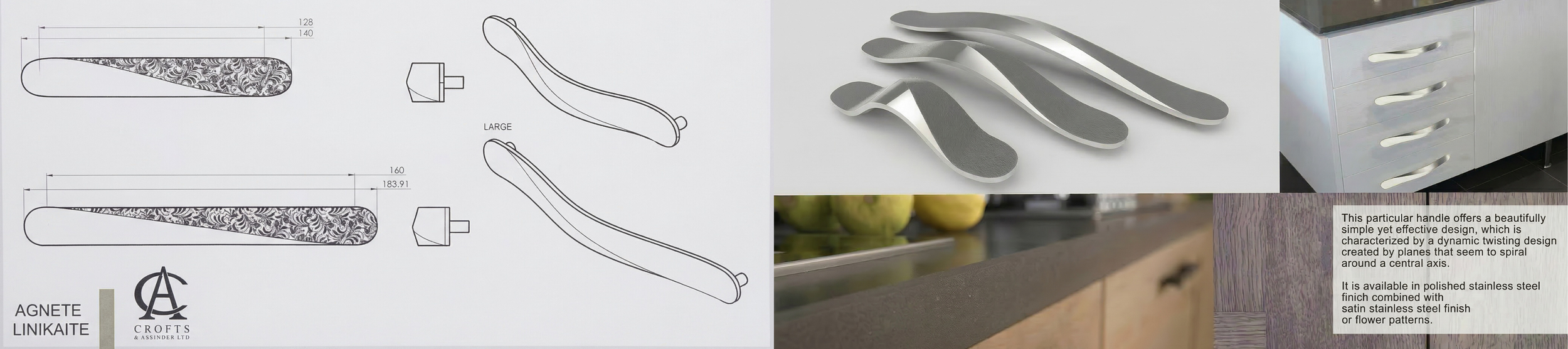
Over ten years ago, the Crofts & Assinder Design Award invited university students to take on a live brief: to design a piece of decorative hardware that could sit comfortably within a real collection. It was a chance to move beyond purely conceptual work and think about materials, manufacturing, and how a product would actually be used day to day. For many, it was their first experience of designing with both creativity and commercial reality in mind.
For Agnete, that challenge became an early stepping stone. Her response to the brief explored fluid, organic form, shaped by influences from her placement at Jaguar Land Rover, and translated into a handle that balanced sculpture with usability.
Since then, her career has evolved significantly across both physical and digital design, leading to her recent promotion to UI/UX Design Lead at Tata Motors. In this role, she not only shapes user experiences but also leads teams, manages stakeholders, and helps guide design direction within complex, large-scale ecosystems.
In this conversation, Agnete reflects on the handle she created for Crofts & Assinder, how her thinking has evolved, and what she would do differently today.

1. It’s been quite a few years since the Crofts & Assinder Hardware Competition. What do you remember about taking part and about the whole process?
What I remember most is how much I appreciated the opportunity to take part in a competition with a real company while I was still at university. It wasn’t a made-up brief, which made the experience far more exciting and engaging. The award ceremony was also a great opportunity for networking and for gaining a better understanding of the professional design world.
2. And how do you feel now when you look back at the handle you created for us? If you were to enter the competition again today, with everything you’ve learned since then, what do you think you might approach differently?
The handle I created at the time was strongly influenced by my placement year at Jaguar Land Rover, where I learned a lot about automotive, organic forms - something that clearly comes through in the design. I haven’t designed handles for a while, but it would be great fun to revisit. If I were entering the competition again today, I think I’d spend more time exploring the underlying philosophy and cultural relevance of the design before starting the form development.
3. Since the competition, your career has evolved significantly across digital and physical design. How has your design approach or thinking changed over the years?
I think as a designer, your approach and thinking naturally evolve as the career develops. You’re constantly required to adapt to changing trends, technologies, and expectations - and the overall design standard continues to shift as well. Today, design has to consider a much wider group of stakeholders, including users, shareholders, and design leadership. At university, you often have far fewer constraints, which can allow for particularly fresh and experimental ideas.
4. Designing decorative hardware is quite different from digital products. Even if it’s been a while, what struck you most about working on a physical object like a handle, whether in terms of form, texture, or the way people interact with it?
I’ve always believed that design is design - whether physical or digital - and that a strong designer can adapt their approach across disciplines. In both cases, thinking about the end user and how they interact with the product is essential. There’s also something very appealing about designing a handle: it’s such a simple object at its core, yet it allows for a lot of exploration in form, ergonomics, and expression.
5. Congratulations again on your promotion to UI/UX Design Lead at Tata Motors! What has stepping into a leadership role taught you about guiding design direction within complex ecosystems?
Thank you. Stepping into a leadership role has highlighted just how critical communication is, especially when managing multiple team members and working with external stakeholders. It becomes just as important as design skill itself - something that isn’t always taught in design school. Clear communication can be the difference between a project succeeding or falling apart.
6. For new designers entering competitions today, what advice would you give them about approaching a brief or expressing their design voice?
My advice would be to follow a structured design process: researching benchmarks, creating a strong mood board, and allowing time for exploration and refinement. When timelines are tight, it’s tempting to skip steps, but you can’t really shortcut a good design process.
7. Finally, what are you currently excited about in your work or in the wider design industry?
I’m currently very excited about the work we’re doing at Tata Motors. My team has recently expanded, and we now have a really strong mix of skills that enables us to execute high-quality design. I’m genuinely excited about what we’ll be creating in the near future.
We’re thrilled to look back at Agnete Linikaite’s journey and see how the Crofts & Assinder Design Award helped shape it. Competitions like this give emerging designers the chance to explore materials, understand the realities of production, and test their ideas in a real-world setting. We have always wanted to support new talent, and reflecting on the award reminds us why giving young designers space to experiment and grow has always been so important to us.